See the full reach of every recorded risk

Every risk with a score, a status, an owner and a mitigation plan, traced along connections to show its real reach, not just the one component it was logged against.

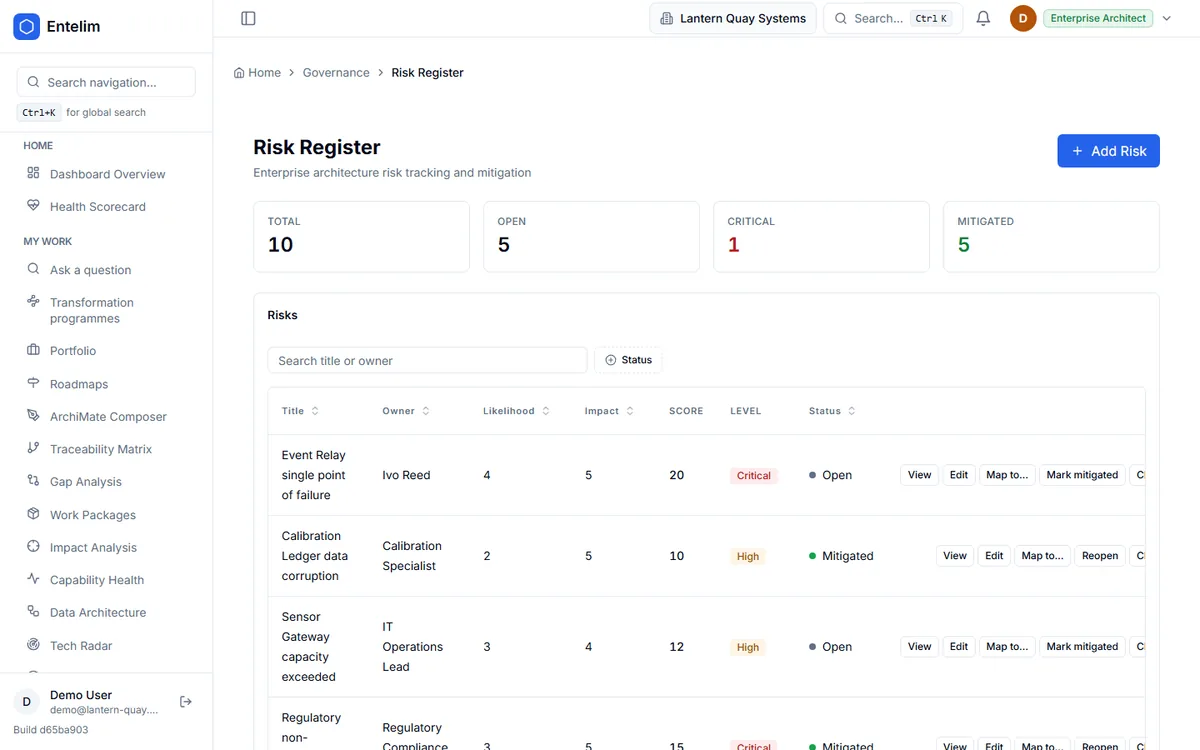
Screenshot of the Risk Register module.
The risk register, with likelihood, impact and a mitigation plan recorded for each risk.
Opens the risk register, which ranks every risk by the number of model elements it reaches and names them. Following one named application opens its impact graph, showing what depends on it and what it depends on.

Who it is for

Made for the people who answer for this.

  • A risk owner who keeps the register.
  • A CTO who needs to know which risks sit on the revenue-critical path.
  • A security or compliance lead looking for control gaps.

Questions it answers

Ask it the questions you are asked.

Which risks sit on our revenue-critical path?

Asked by a CTO.

Which risks touch this part of the architecture?

Asked by a security architect.

Who owns the mitigation for this risk?

Asked by a risk owner.

Which risks carry the most exposure now?

Asked by a board member.

How it works

From your data to an answer, in steps.

  1. Step 1

    Record the risk

    Score how likely it is and how much damage it would do, set a status and an owner.

  2. Step 2

    Plan the mitigation

    Attach the plan and score it again once it is in place.

  3. Step 3

    Follow the connections

    The risk shows up wherever its impact would reach.

  4. Step 4

    Review what matters

    See which risks carry the most exposure.

What is enterprise risk management?

Enterprise risk management is the practice of recording, scoring and tracking every risk that could get in the way of an organisation's objectives in one place, instead of each team keeping its own list. The COSO and ISO 31000 frameworks most risk and compliance functions already work from describe the same basic loop: log the risk, score how likely it is and how much damage it would do, assign someone to own it, and score it again once a mitigation is in place — the inherent risk before that work starts, the residual risk after.

A buyer searching for enterprise risk management software is typically looking for whatever makes that loop survive contact with a real organisation: one register instead of several spreadsheets, a scoring method that means the same thing wherever it's applied, a record of how a score moved over time rather than just its latest value, and a way to see at a glance which risks carry the most exposure right now.

What a static register can't do is keep up with the fact that a risk rarely stays confined to the one thing it was originally logged against — the system, process or programme it threatens shifts as the architecture around it changes, and a document frozen at the moment it was written has no way to notice.

What this module does

Entelim's Risk Register module runs that register in software, not a spreadsheet: each risk carries a single score for how likely it is and how much damage it would do, a status, an owner and a mitigation plan. Ask which risks matter, and the answer doesn't stop at the element a risk was originally logged against — it follows the same connection chain that answers what breaks, so a risk shows up everywhere its impact would actually reach.

Start today

Connect your tools. Get a cited answer.

Free for up to three people, with no trial clock. Self-host it free under AGPL-3.0, at any size.