CIO dashboard software for CTOs and technology leaders
A CIO dashboard brings the state of the whole technology estate onto one screen: what you run, what it costs, what's overdue for a decision and what two teams are quietly paying for twice. Entelim builds that dashboard from a single shared model, with a CTO scorecard, a health scorecard and an application rationalisation view that score the estate the same way every time you open it. A CTO or CIO can start on the free Community plan and see a first picture as soon as the inventory is in.

What a CTO or CIO does
A CTO or CIO is accountable for what the organisation's technology costs, what it risks and where it is heading, and answers for all three to the board and the finance function. The job turns from opinion to evidence the moment someone asks a question with a number attached: how much are we paying for the same thing twice, which systems nobody owns, what a proposed investment actually returns. A CIO dashboard earns its place by answering those questions from the same model every time, rather than a slide rebuilt by hand before each board meeting.
The questions you get asked
- What are we paying for twice? For scale-up CTOs and VPs of Engineering.
- Which risks sit on our revenue-critical path, and who owns the mitigation? For scale-up CTOs and VPs of Engineering.
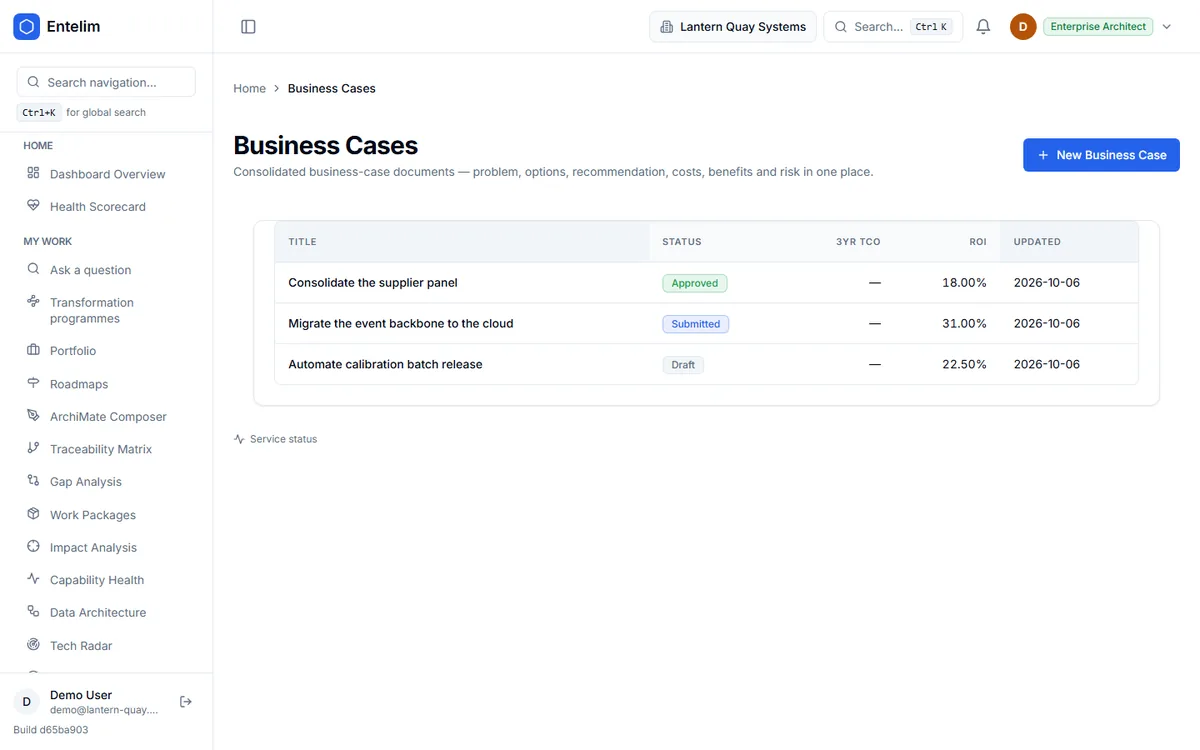
- What is the business case for this investment? For enterprise architecture teams putting a transformation case in front of the CIO.
The screens you will use
- The AI chat, the one place every role asks in plain words, for a quick check before you open a dashboard.
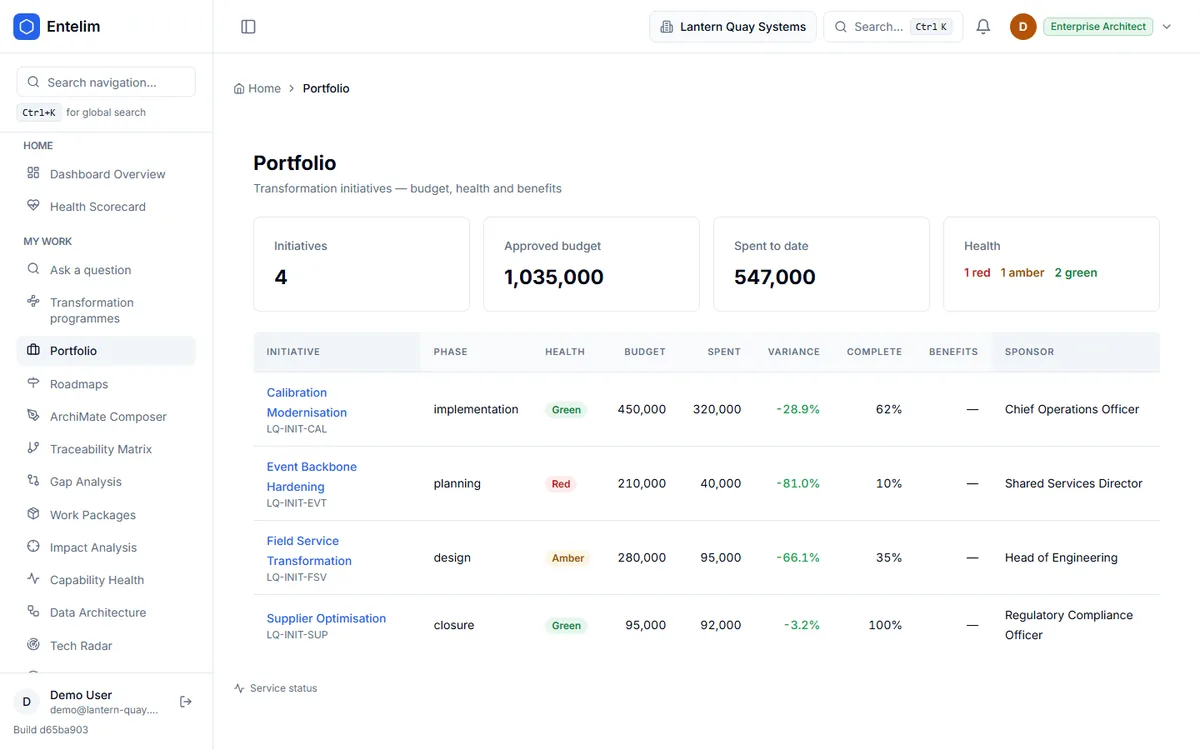
- The CTO scorecard and the health scorecard, together giving the share of your applications still on a supported vendor version, the oldest open architecture exceptions to escalate, and one score built from risk counts, the review board's pipeline and how far your change programmes have moved through their phases.
- Rationalisation — see Rationalisation — scoring every application Tolerate, Invest, Migrate or Eliminate, and turning the result into the consolidation list that answers what you're paying for twice.
- Ownership coverage and capabilities with no owner, broken down by business unit, so a gap in accountability is visible before an auditor finds it.
- Roadmaps — see Roadmaps — the gap register between today's stages and the target state, and the projects closing each one.
- Tech radar, classifying the technology already in your model as adopt, trial, assess or hold.
- The review board — see Architecture Review Board — where a change goes through sessions and a recorded decision before it ships.
Enterprise and solution architects do the day-to-day modelling behind these screens; see how they work on enterprise architect tools.
A week with Entelim
- Open the health scorecard and the CTO scorecard for one read of risk, the review board's pipeline and which applications still run a supported vendor version, with the oldest open exceptions ready to escalate.
- Check rationalisation's consolidation list for what you're paying for twice, and ownership coverage for which business unit has an application nobody has claimed.
- Open the roadmap's gap register for the stage a proposed change sits in, and the business case behind it, with the capex, annual opex, three-year TCO, ROI, payback and NPV recorded on it. The costs of the capability, initiative or solution it's linked to can fill blank cost fields and are shown beside what was entered as a cross-check.
- Send the change to the review board, and decide it once its sessions and evidence are recorded.
- Set direction on the tech radar for anything newly adopted, trialled, assessed or put on hold.
What you hand over
The CTO scorecard's oldest open exceptions, escalated; a consolidation list with a target date and an estimated annual saving against every entry; a roadmap's gap register; a business case with capex, opex, three-year TCO, ROI, payback and NPV; and a review board decision with its conditions attached.
Works with
Sign your whole technology leadership team in the way they already sign in everywhere else: connect single sign-on over OpenID Connect or SAML, included from the Team plan. Carry the same questions into a conversation you're already having by connecting an AI assistant such as Claude, read-only and scoped to your own organisation's data, on every plan including the free one.
Limits
The scorecards answer from what is recorded against an application: one with no vendor product linked counts toward neither a supported nor an unsupported share, rather than being guessed into one. A business case's benefit and payback figures are the ones you enter, not ones Entelim estimates for you. A review board decision is still made by the people sitting on it; Entelim holds the evidence and the record, not the judgement.
Frequently asked questions
What does it cost for a whole IT team?
Community is free for one organisation of up to three people, with the CTO scorecard, health scorecard and rationalisation all included. A growing technology team moves to Team, priced at $29 per editor a month, where anyone who only reads a dashboard or asks a question stays free. Enterprise is sold by contract, from $24,000 a year, and adds SAML single sign-on and unlimited editors.
Can the board see the numbers without a paid seat?
Yes. Anyone who only reads a dashboard or asks a question in the AI chat is free, on every plan including Enterprise. An editor seat is only needed to change the model itself: updating a roadmap, recording a rationalisation decision, or taking a case through the review board.
How fast can we have a first picture?
As soon as your applications are imported. An ArchiMate Open Exchange or .archimate export, or a CSV or Excel list, brings your inventory in with a history of what arrived and when. The CTO scorecard and health scorecard read that same import immediately, and rationalisation's scoring and duplicate detection run on demand, so the first pass can be done the same day.
Do you offer an assessment before we commit?
Yes. The architecture health check is a fixed-price assessment, run on your own application data rather than a demonstration, that delivers a written report within two weeks of kickoff covering ownership gaps, duplicate spend, rationalisation scores and contract renewals, plus a read-out call to walk your team through what it found.
Do I need to learn ArchiMate to use the CIO dashboard?
No. The CTO and CIO workspace is built around dashboards you read and a plain-language AI chat, not a modelling canvas. Architects on your team keep working in ArchiMate underneath; you see the scorecards, the consolidation list and the roadmap it produces, not the notation behind it.
Start free
Start free on the Community plan for one organisation of up to three people, with the CTO scorecard, health scorecard and rationalisation included from day one. A technology team that outgrows it moves to Team, priced per editor, where everyone who only reads a dashboard stays free. For a guided first assessment, see the architecture health check. See full pricing.
Other roles
- Business architect tools that tie capabilities and value streams to the work that changes them
- Chief architect software for an architecture function you can account for
- Data architect tools that tie every data flow to a real element in the model
- Enterprise architect tools for one model, not three disconnected ones
- IT portfolio manager software for a portfolio you can defend at budget time
- Know what you run, who owns it and what breaks if it fails — starting from GitHub or Jira
- Know what your startup runs and who owns it, from the day you connect GitHub
- Security architect tools that show what a risk reaches, not just where it was logged
- Solution architect tools for a design the review board can actually decide on
- Architecture Review Board
- Take a change through the review board with its evidence pinned to the decision
- What breaks if this service or platform fails, and who gets called?
- What happens to my business if this person, supplier or system underperforms?
- Which contracts renew soon, and what depends on them?
Choose a plan
Annual billing is selected; monthly is one click away. Any tax due is shown on the payment page before you pay.
Import your model and get a free, cited answer to what breaks if a system fails, in minutes.