Chief architect software for an architecture function you can account for
Chief architect software has one job the enterprise architect's tools do not: showing whether the architecture function itself is working. How much of the estate is modelled and connected, how long a change waits for the review board and what it decided, which technology is adopted and which is on hold, and where the model still has gaps. Entelim reads all of it from the same model the architects work in, so the answer to "how is architecture doing" is a screen, not a slide assembled for the meeting. A chief architect can start on the free Community plan.

What a chief architect does
A chief architect is accountable for the architecture function: the standards the estate is built to, the decisions that have been taken and why, and the review process every significant change goes through. Where an enterprise architect works the model itself and a solution architect takes one design from idea to approval, the chief architect answers upward and across: to the CTO and the business for what architecture has delivered, and to the architects for what good looks like. The job gets hard the moment someone asks for evidence — how many reviews are waiting, how often the board approves, which part of the model nobody has connected — and the honest answer lives in five different places.
The questions you get asked
- Is the review board keeping up, and what has it decided? For enterprise architecture teams running formal governance.
- What breaks if this platform fails, and who gets called? For scale-up CTOs and VPs of Engineering, 50-500 people.
- Which value streams are at risk because the capabilities under them are immature? For enterprise architecture teams and the CIO they report to.
The screens you will use
- The health scorecard, one place for the architecture's own measures: a health score weighted from risk posture, capability coverage and governance, the review pipeline by state, open risks and ArchiMate elements counted by layer. Where something has not been measured, the scorecard says so rather than showing a number.
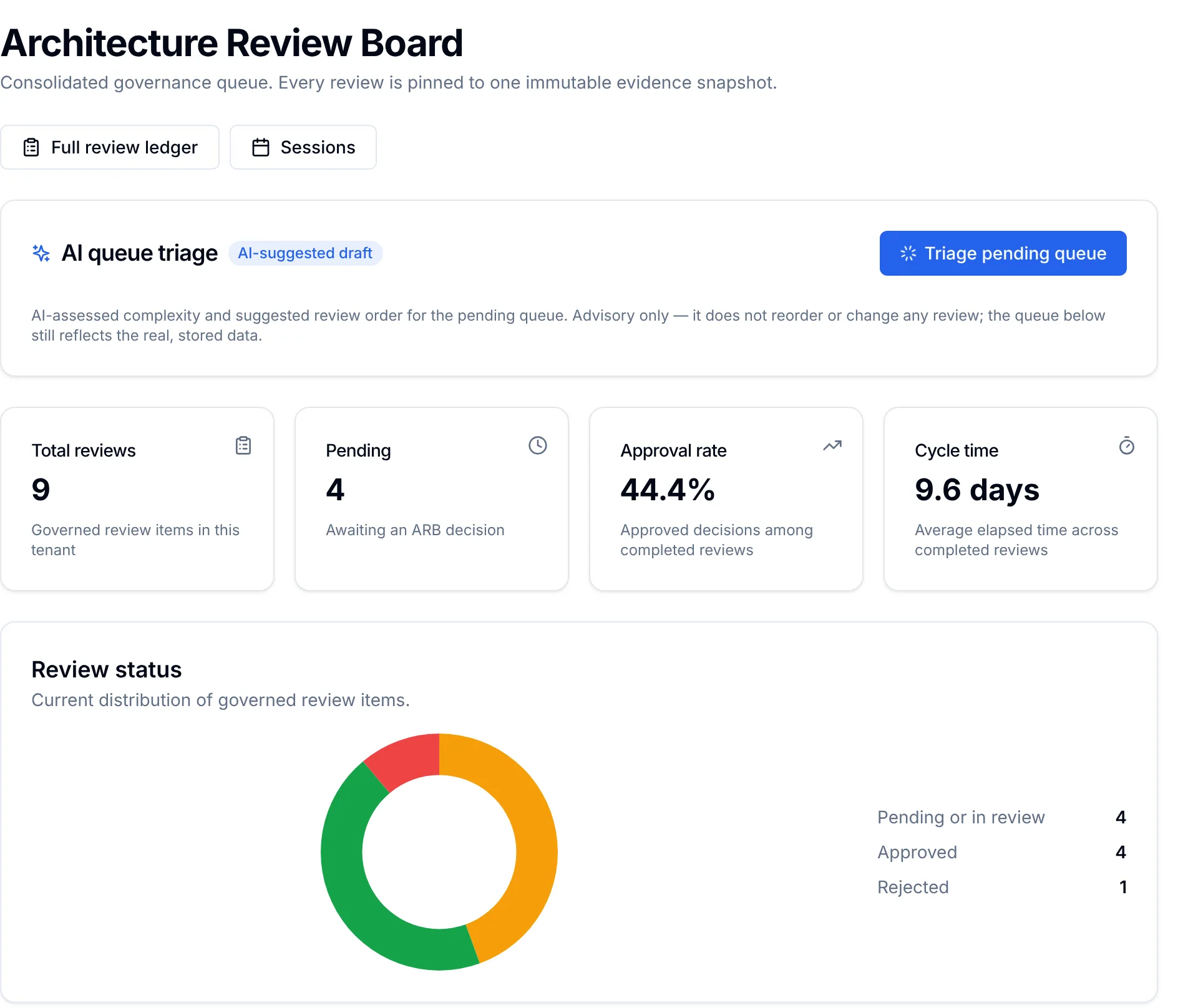
- The review board, whose dashboard shows total reviews, how many are pending, the approval rate and the average cycle time, with every review listed by number, type, risk and state — see Architecture Review Board.
- Architecture decisions, the record of decisions taken: context, the decision, consequences and the alternatives considered, a status of proposed, accepted, deprecated or superseded, a review date, and the ArchiMate elements each decision affects.
- The traceability matrix, with a coverage and gap analysis showing how much of the model is connected from drivers through goals, requirements and capabilities down to applications — and how many elements are orphaned.
- Capability health, scoring each business capability on maturity, coverage and risk, with domain-level health, at-risk hotspots and the coverage and maturity shortfalls behind them.
- The tech radar, where each device, system software and technology service already in the model is classed adopt, trial, assess or hold, with a rationale, review date and requesting initiative recorded.
- The AI chat, for a plain question about one element and what it connects to; any element then opens in the Composer — see Digital twin of your organisation.
- Roadmaps, with plateaus, the gap register and work packages on one timeline — see Roadmaps.
A week with Entelim
- Open the health scorecard for the state of the model and the review pipeline.
- Open the review board dashboard: what is pending, what was decided, how long it took.
- Check the traceability matrix's coverage figures for the part of the model that is not yet connected, and capability health for where the shortfalls sit.
- Record the decisions the board took in the architecture decisions register, linked to the elements they concern.
- Classify any technology that has moved on the tech radar, with the reason and a review date.
What you hand over
A health scorecard that reads from the live model. The review board's volume, approval rate and cycle time. A register of architecture decisions with their status. A technology radar with a rationale and review date on each classification. A coverage report from the traceability matrix showing what is connected and what is not.
Works with
An imported Archi or ArchiMate Open Exchange model brings the existing model in, so the scorecards read from the work already done — see import your model. Connect an AI assistant, read-only and scoped to your organisation's data, to ask the same questions from a tool you already use.
Limits
Every figure is read from what is recorded in the model: the health scorecard and the coverage analysis are only as complete as the model behind them, and a measure with nothing recorded shows as not measured rather than as zero. The review board's decision is made by the people who sit on it; Entelim holds the evidence and the record, not the judgement.
Frequently asked questions
How is this different from the enterprise architect tools?
The enterprise architect works the model: elements, relationships, impact, roadmaps. A chief architect uses the same model to account for the function — review board throughput, decisions on record, technology standards and how much of the estate is connected. See enterprise architect tools for the modelling side.
Does it follow TOGAF and ArchiMate?
Yes. The model is built on ArchiMate 3.2 across the business, application, technology and motivation layers, and design work is tracked through the stages of TOGAF's Architecture Development Method.
Can the CTO see these numbers without a paid seat?
Yes. Anyone who only reads a dashboard or asks a question in the AI chat is free on every plan. An editor seat is for people who change the model: recording a decision, classifying technology, taking a review forward.
Who needs a paid seat?
Editors on the Team plan, priced at $29 per editor a month. Community covers one organisation of up to three people at no cost, and Enterprise, from $24,000 a year, adds SAML sign-in and unlimited editors.
Start free
Start free on the Community plan for one organisation of up to three people. A larger architecture team moves to Team, priced per editor, where people who only read and ask stay free. See full pricing.
Other roles
- Business architect tools that tie capabilities and value streams to the work that changes them
- CIO dashboard software for CTOs and technology leaders
- Data architect tools that tie every data flow to a real element in the model
- Enterprise architect tools for one model, not three disconnected ones
- IT portfolio manager software for a portfolio you can defend at budget time
- Know what you run, who owns it and what breaks if it fails — starting from GitHub or Jira
- Know what your startup runs and who owns it, from the day you connect GitHub
- Security architect tools that show what a risk reaches, not just where it was logged
- Solution architect tools for a design the review board can actually decide on
- Architecture Review Board
- Take a change through the review board with its evidence pinned to the decision
- What breaks if this service or platform fails, and who gets called?
- What happens to my business if this person, supplier or system underperforms?
- Which contracts renew soon, and what depends on them?
Choose a plan
Annual billing is selected; monthly is one click away. Any tax due is shown on the payment page before you pay.
Import your model and get a free, cited answer to what breaks if a system fails, in minutes.