Know who you depend on, and what breaks if they fail

Every supplier behind your applications in one list, linked into what depends on them, with single-supplier concentration flagged per capability.

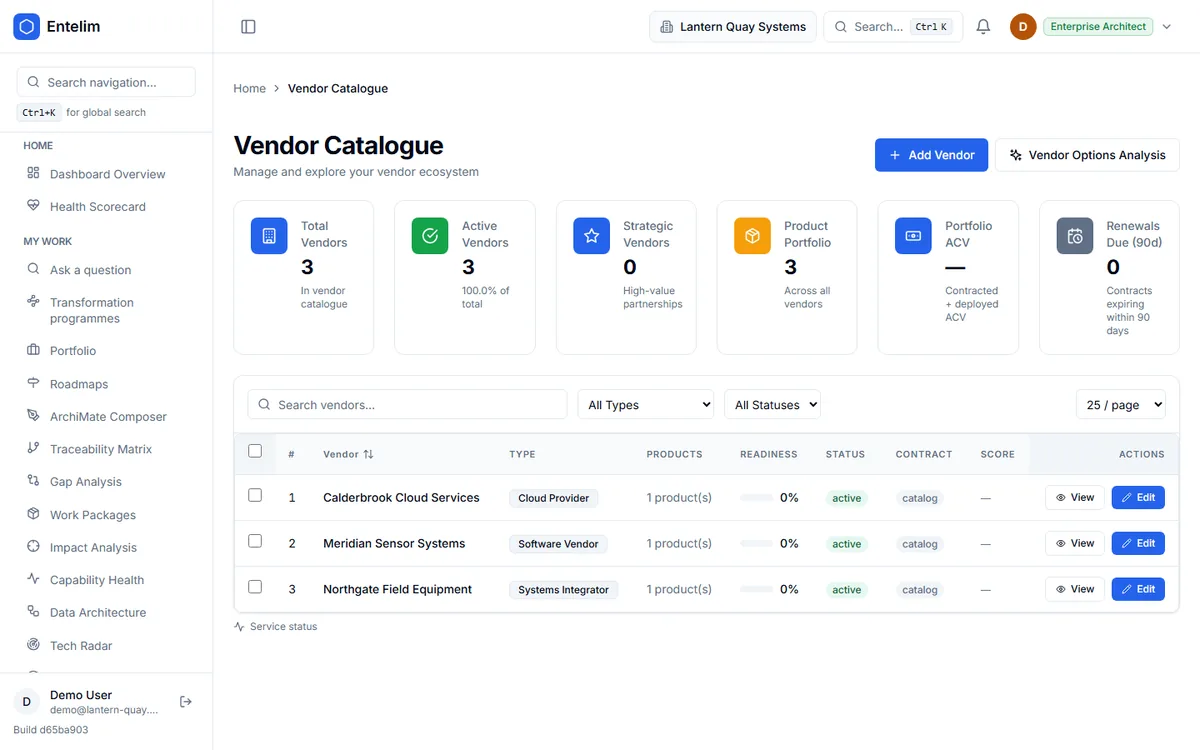
Screenshot of the Vendors module's vendor catalogue.
The vendor catalogue, with each vendor's type, products and contract status.

Who it is for

Made for the people who answer for this.

  • A procurement or vendor manager who owns the supplier list.
  • An architect or risk owner asking what a vendor failure would take down.

Questions it answers

Ask it the questions you are asked.

Which applications depend on this vendor?

Asked by an architect.

Where are we reliant on a single supplier?

Asked by a risk owner.

Which contracts renew soon, and what depends on them?

Asked by a procurement lead.

What is this vendor's contract status?

Asked by a finance lead.

How it works

From your data to an answer, in steps.

  1. Step 1

    List the vendors

    One record per supplier.

  2. Step 2

    Link what they provide

    Applications and contracts trace back to the vendor.

  3. Step 3

    Read the concentration

    Each record flags where it is the only supplier.

  4. Step 4

    Check what breaks

    See what depends on the vendor if it fails.

What is vendor management software?

Vendor management software is the system that holds every supplier an organisation buys from — who they are, what they provide, and what contracts and spend trace back to them — so that "who do we depend on, and for what" has one answer instead of living in separate spreadsheets per department. At its simplest that's a directory: one record per vendor, not one per purchase order. Done well, it also tracks each vendor's standing — contract status, and how concentrated the organisation's spend or dependency is on that one supplier — because a directory only earns its keep if it also tells you something about exposure.

Vendor risk management software is the part of that discipline aimed specifically at exposure: which vendors would take a critical process or application down with them if they failed or ended the relationship tomorrow, and which capabilities the organisation is sourcing from only one supplier rather than several. It's a question that rarely gets asked until a vendor actually has an outage, because answering it ahead of time means linking a vendor record to everything that depends on it technically, not just contractually — the harder, less common half of vendor management software.

What this module does

Vendors sits next to Applications as the other half of the same picture: who you buy from, which applications and contracts trace back to them, and what actually breaks if one of them lets you down. It's the record vendor risk questions and procurement renewals both read from, so a vendor's status never has to be entered twice. Each vendor's own record flags, capability by capability, where it is the only supplier in place — a concentration risk a plain vendor directory would otherwise never surface.

Start today

Connect your tools. Get a cited answer.

Free for up to three people, with no trial clock. Self-host it free under AGPL-3.0, at any size.